


Photo by Michael Jerrard on Unsplash
Ravens have held a powerful place in mythology, folklore, literature, and modern art for centuries. Their dark feathers, piercing calls, intelligence, and habit of appearing in stark landscapes have made them enduring symbols of mystery. But the meaning of a raven is not limited to one ominous idea.
Across cultural traditions, raven symbolism can point to death and the afterlife, secret knowledge, cleverness, change, fate, and personal renewal. The right interpretation depends on the cultural context and the role the bird plays in a particular story or image.
Key Takeaways
- Ravens commonly symbolize mortality, transition, mystery, wisdom, trickery, and transformation.
- In Norse mythology, Odin’s ravens Huginn and Muninn connect the bird with thought, memory, and gathered knowledge.
- In some Indigenous traditions, Raven is a clever trickster figure whose stories explore adaptability and unexpected lessons.
- Modern literature and art continue to use ravens for themes of grief, darkness, rebirth, destiny, and introspection.
Table of Contents
- What Does a Raven Symbolize?
- Why Ravens Are Associated With Death
- The Raven as a Trickster in Indigenous Traditions
- Raven Meaning in Norse Mythology: Thought and Memory
- Ravens as Symbols of Change and Transformation
- Raven Symbolism in Literature, Film, and Music
- How to Interpret a Raven in Art, Dreams, Tattoos, or Decor
- Common Misconceptions About Raven Meaning
- Why the Raven Endures as a Powerful Symbol
What Does a Raven Symbolize?
At its broadest, the raven symbolizes the unknown. It is often associated with the edges of ordinary experience: mortality, hidden truths, difficult transitions, memory, and the unpredictable consequences of knowledge.
This is why ravens can seem contradictory. They may be frightening messengers in one setting and wise guides in another. They can represent chaos, yet also insight. They may be connected with endings, while also standing for rebirth and change.
The most common symbolic meanings of ravens include:
- Death and mortality, especially as an omen or guide connected to the dead.
- Transition, representing movement between one state of being and another.
- Wisdom and knowledge, particularly observation, thought, and memory.
- Trickery and adaptability, reflecting wit, resourcefulness, and disruption of expectations.
- Transformation, including the need to release outdated habits or identities.
- Melancholy and remembrance, especially in Gothic literature and art.
Rather than treating a raven as a universal sign of bad luck, it is more useful to ask what the bird is doing, where it appears, and what tradition or creative work frames its meaning.
Why Ravens Are Associated With Death
The raven’s connection to death is one of its oldest and most recognizable meanings. In many cultural imaginations, ravens are linked with battlefields, illness, loss, and the border between the living and the dead. Their presence in these settings made them natural figures of foreboding.
Yet raven symbolism is more complex than a simple warning of disaster. In some traditions, the raven acts as a psychopomp, a being understood to guide souls on their passage to the afterlife. Seen this way, the raven does not merely announce death. It represents passage, spiritual movement, and the mystery of what lies beyond life.
This distinction matters. A raven can symbolize the painful reality of mortality while also suggesting that death is a threshold rather than a meaningless end. In memorial art, dark fantasy, and Gothic imagery, the bird may therefore evoke grief, remembrance, and the enduring presence of the past.
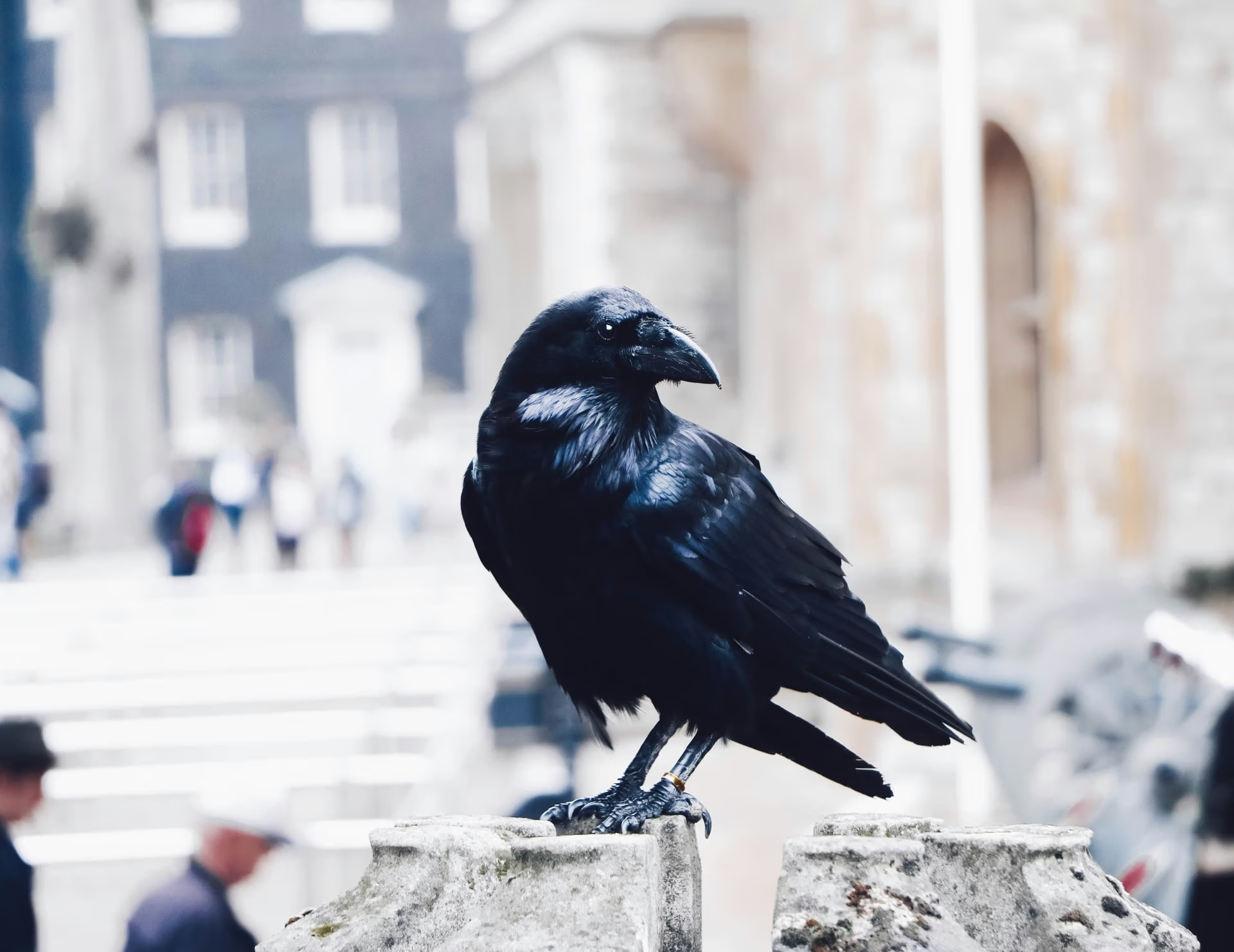
Photo by Kasturi Roy on Unsplash
The association with darkness also helps explain the raven’s lasting visual power. Black plumage against a pale sky, bare branches, moonlight, or an abandoned setting creates an immediate contrast between visible life and the unknown. That mood is a major reason ravens remain central to dark aesthetics and symbolic art.
For a deeper look at why unsettling subjects can be compelling rather than merely frightening, explore the psychology of morbid curiosity.
The Raven as a Trickster in Indigenous Traditions
In many Indigenous traditions of North America, Raven is not simply a dark omen. Raven often appears as a clever, disruptive, and sometimes mischievous trickster figure. Stories associated with communities including the Haida, Tlingit, and Navajo feature Raven as an important character through which questions about human behavior, knowledge, and survival can be explored.
The trickster role is significant because it challenges neat divisions between wisdom and foolishness, order and chaos, or right and wrong. Raven’s schemes may create trouble, expose arrogance, or produce unexpected lessons. The character’s intelligence does not always make Raven noble or predictable, but it makes Raven memorable.
What the trickster raven represents
As a symbol, the trickster raven can suggest:
- Adaptability in difficult or changing circumstances.
- Creative problem-solving when direct solutions are unavailable.
- Humility, because cleverness can bring both rewards and consequences.
- Unexpected learning, since insight can arise from confusion, mistakes, or disruption.
It is important not to flatten distinct Indigenous traditions into a single interpretation. Raven stories belong to particular peoples and cultural settings. When using raven imagery inspired by these traditions, specificity and respect are essential. A generic “Native American raven meaning” can erase meaningful differences between nations, stories, and ceremonial contexts.
Raven Meaning in Norse Mythology: Thought and Memory
Ravens also symbolize wisdom in Norse mythology through Odin’s companions, Huginn and Muninn. Their names are commonly understood as Thought and Memory. These two ravens travel through the world, gather what they observe, and return to Odin with knowledge.
This imagery gives raven symbolism an intellectual dimension. The raven becomes a figure of attentive observation, curiosity, reflection, and the gathering of information. Wisdom, in this sense, is not passive. It requires seeking, noticing, remembering, and making meaning from what has been learned.
The Norse raven can be especially relevant when an image or personal symbol involves:
- Research, study, or investigation.
- Memory and the influence of the past.
- Thoughtful decision-making.
- A search for hidden patterns or difficult truths.
- A desire for deeper understanding rather than quick answers.
This role helps explain why raven imagery appears so often beside books, old maps, clocks, forests, and other objects associated with knowledge and time. It suggests that insight often comes from sustained attention to what others miss.
Ravens as Symbols of Change and Transformation
A raven may also symbolize transformation. The idea is closely linked to the natural process of molting, in which birds shed old feathers and grow new ones. Symbolically, this becomes a powerful image of renewal: something old must be released to make room for what comes next.

Photo by Cristina Glebova on Unsplash
When a raven appears during a period of uncertainty, its symbolic meaning can be read as an invitation to consider change seriously. That does not mean every difficult event is positive or that transformation is easy. It means change can involve both loss and the possibility of growth.
A practical way to interpret the raven as a symbol of change
Use these questions when the raven feels connected to a personal transition:
- What has reached its limit? Identify a habit, assumption, role, or fear that no longer fits.
- What needs to be released? Consider what you may be holding onto from familiarity rather than usefulness.
- What knowledge can be carried forward? Transformation does not require forgetting the past. It can mean learning from it.
- What new form of adaptability is required? Look for the practical adjustment that will help you meet the next stage.
Under this interpretation, the raven is not a promise that change will be painless. It is a reminder that renewal often asks for courage, flexibility, and patience.
Raven Symbolism in Literature, Film, and Music
Modern culture has kept raven symbolism alive by returning to its most emotionally charged meanings: darkness, grief, destiny, spiritual guidance, and rebirth.
One of the most influential literary examples is Edgar Allan Poe’s “The Raven”. In the poem, the bird is an unsettling and persistent presence that deepens the narrator’s sorrow. The raven’s symbolic force comes from its relationship to memory, loss, and the fear that grief may never loosen its hold.
That literary association has shaped the raven’s modern Gothic identity. In art and design, a raven often communicates melancholy, introspection, old sorrow, and the return of unwanted memories. It is especially effective in imagery that explores the tension between beauty and darkness.
Raven imagery also appears in The Crow, where the bird functions as a spiritual guide and is linked with rebirth and transformation. In Led Zeppelin’s “The Battle of Evermore,” ravens are invoked as heralds of destiny, adding a mythic atmosphere to the song’s world.
These examples show why the symbol remains flexible. A raven can be mournful without being hopeless, dark without being evil, and supernatural without having one fixed spiritual meaning.
How to Interpret a Raven in Art, Dreams, Tattoos, or Decor

Photo by Jill Dimond on Unsplash
There is no single correct answer to “What does it mean when I see a raven?” Symbolic meaning is shaped by context, personal associations, and cultural references. Avoid treating a raven sighting as proof that a specific event will happen.
Instead, interpret the bird through the details around it.
Raven interpretation checklist
- Setting: Is the raven in a cemetery, a forest, a battlefield, a library, a city street, or open sky?
- Action: Is it flying, calling, observing, feeding, guiding, or sitting silently?
- Companions: Is it alone, paired with another raven, or shown in a flock?
- Visual tone: Does the image feel mournful, threatening, scholarly, mystical, defiant, or peaceful?
- Reference: Does it evoke Norse mythology, Gothic literature, a particular Indigenous story, or a contemporary work?
- Personal connection: Does it relate to grief, study, independence, resilience, a major change, or artistic identity?
For example, a raven above a battlefield may draw on death and fate. A raven beside books may emphasize thought and memory. A raven in flight over a bright horizon can suggest departure, freedom, or transformation. A raven tattoo may combine several of these meanings, especially if it includes a moon, skull, key, feather, clock, or branches.
Common Misconceptions About Raven Meaning
A raven does not always mean death
Death is a major association, but it is only one part of the symbol’s history. Ravens can represent intellect, travel, observation, renewal, trickery, survival, and spiritual passage.
A raven and a crow are not always symbolically interchangeable
Both birds share dark visual associations and appear in similar artistic settings, but they are distinct birds and may have different roles in stories and symbols. A particular work may deliberately choose a raven because of its ties to Odin, Poe, transformation, or a specific mythic tradition.
Not every raven sighting is an omen
Encountering a raven in nature does not automatically carry supernatural significance. Personal symbolism can still be meaningful, but it is best understood as reflection rather than certainty or prediction.
Raven lore is not one unified belief system
Raven symbolism spans many cultures and eras. Meanings should not be removed from their original contexts or treated as interchangeable. A thoughtful interpretation names its source when possible and leaves room for multiple meanings.
Why the Raven Endures as a Powerful Symbol
The raven lasts because it can carry opposing ideas at once. It is an image of death that can also suggest transcendence. It is a trickster that teaches through disorder. It is a creature of dark landscapes that stands for thought, memory, and the pursuit of wisdom. It represents change without denying the hardship that change can involve.
Whether encountered in mythology, poetry, music, tattoo design, or personal reflection, the raven is most meaningful when read with context. Its darkness is not empty. It invites questions about what has been lost, what remains unknown, and what new understanding may emerge from the threshold between them.
Frequently Asked Questions About Raven Symbolism
Is a raven a sign of death?
A raven can symbolize death, mortality, or the afterlife, particularly in imagery involving battlefields, grief, or spiritual passage. However, it can also represent wisdom, transformation, and adaptability, so it should not automatically be read as a bad omen.
What do ravens symbolize in Norse mythology?
In Norse mythology, Odin’s ravens Huginn and Muninn represent Thought and Memory. They travel through the world and return with what they have learned, making the raven a symbol of observation, knowledge, and wisdom.
What does a raven tattoo mean?
A raven tattoo can signify intelligence, mystery, grief, resilience, spiritual guidance, transformation, or a connection to mythology and Gothic literature. Details such as books, moons, skulls, feathers, or flight direction shape the intended meaning.
What is the difference between raven symbolism and crow symbolism?
Ravens and crows share some dark and mysterious associations, but they are not identical symbols. Ravens are especially linked with Odin, Huginn and Muninn, Poe’s “The Raven,” and themes of memory and transformation. The meaning depends on the specific cultural or artistic context.